
What if I had been the one to find my father that morning?
By Lisa Sugarman, Founder of The HelpHUB™
*WARNING: This article mentions suicide and may be triggering.
What if the smallest moment—like just one step further down a staircase, for instance—could change the outcome of the most profound experience of your life? Well, that question has haunted me lately in a way it never has before.
It’s been over a decade since I discovered that my father died by suicide and not from a heart attack like I was told when I was a child. And during these last 10+ years since I learned the truth, I’ve carried a pretty heavy load of grief, sadness, and confusion. I’ve also carried The Why, which was probably the most cumbersome piece for me. But what I haven’t carried is guilt. And for that, I consider myself grateful.
Maybe it’s because I gave myself grace since I was only ten years old when my father died and no one knew he was suffering. I mean, there were no visible signs, no red flags, no cries for help and not even my mother had an inkling he was struggling. And even if she did, we didn’t have the language to address it back in the late ‘70s because mental health just wasn’t something people talked about.
That’s why, until only recently, I’ve never felt guilt about my father’s suicide because I knew his death was beyond mine or anyone else’s control.
Or was it?
I recently had a conversation where I was asked a question about my father’s death that I had never been asked before. And that singular question gave me an entirely new thought loop to consider—one I’d really never considered before, even after endlessly ruminating over every aspect of my father’s death for so many years.
See, the night before my father died, he’d told my mother that he was going to sleep in the sofa bed in our family room so he could watch the Red Sox game without disturbing her. Only unbeknownst to her, he’d planned to end his life that night. And that’s exactly what he did.
The following morning, knowing he had slept in the basement, I crept down the stairs to sneak into bed and kiss him good morning before I left for camp for the day. I made it to the bottom stair, so close that I could see the silhouette of my father’s body lying with one arm over his head—his signature sleeping position. But just before I stepped off the staircase, my mother intercepted me, whispering over the banister, Don’t wake Daddy, honey. He was up late watching the baseball game. So, I reluctantly turned around, climbed back upstairs, wrote him a short have-a-great-day note, and then walked to the corner of our street with my mom to catch the camp bus.
I never saw my father again.
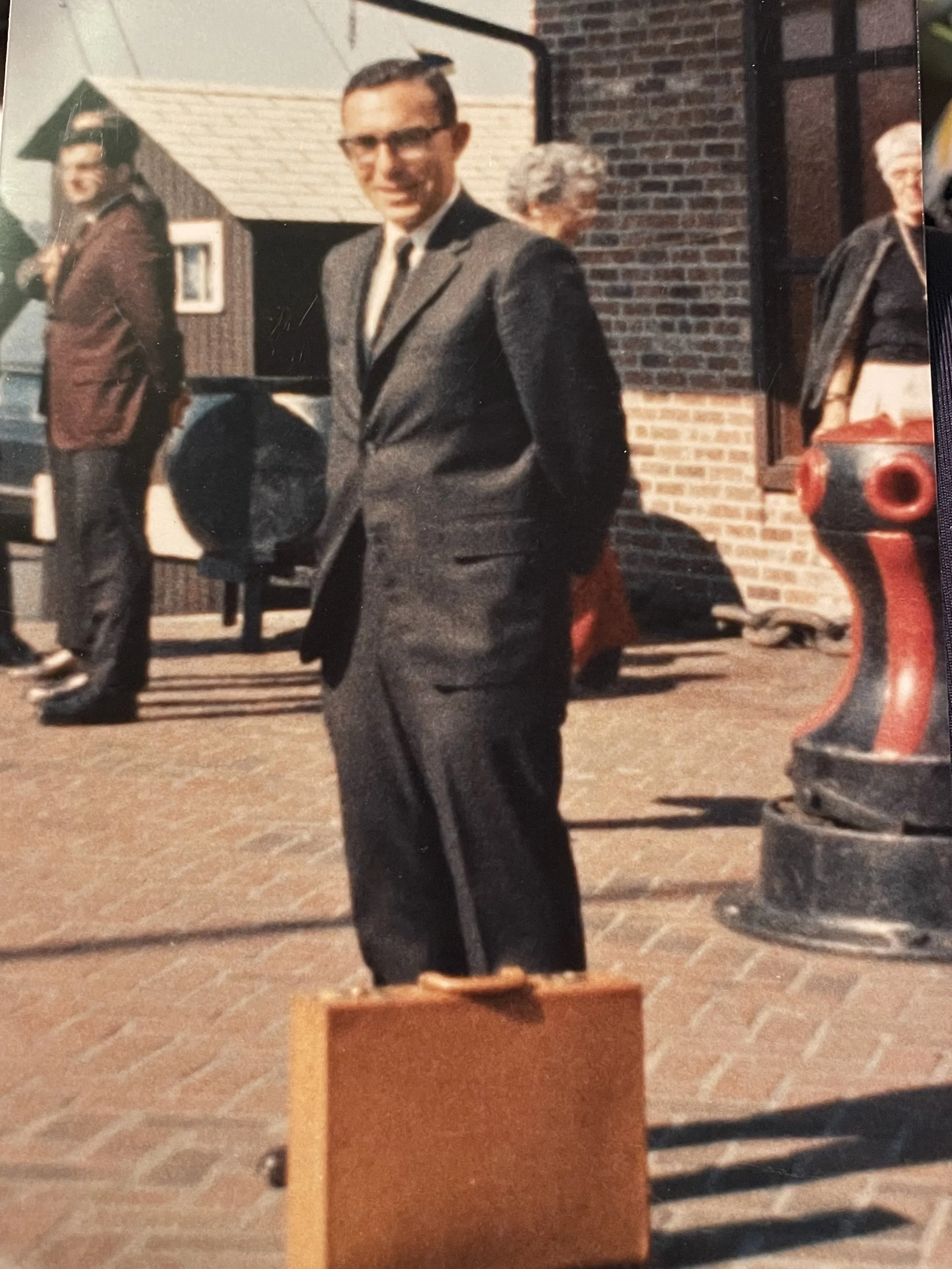
Now here’s how a single question unearthed the possibility of an alternate outcome to my story that I’d never really considered before …
During a recent interview where I revealed this part of my survivor story, a podcast host asked me something that caught me completely off guard: Do you ever feel guilty that you didn’t go downstairs the morning your father died?
And that question stirred something in me that I hadn’t expected:
What if I had reached the bottom of our basement stairs that morning and had been the one to find my father?
What if he was still alive when I tried to sneak downstairs and into bed with him to give him a kiss goodbye before I left for camp?
What if I could've saved him?
I’m sharing this now, in the spirit of Mental Health Awareness Month, because this is what mental health looks like. Mental health isn’t always about an active crisis. Sometimes, like in my case, it’s about what happens after a suicide loss. It’s about navigating the emotional residue that you can’t seem to cleanse no matter how hard you try.
It’s the wondering:
If we’d talked more about mental health in my family...
If my dad had known he could ask for help without shame...
If I’d known what depression was...
Maybe the story would have ended differently.
For me, I’ve realized that what I’m feeling are feelings of longing. There’s an active part of my brain and heart that wants to rewrite that moment on the stairs and do things differently, even knowing I probably couldn’t have changed a thing.
It’s an aching to go back—not only to maybe prevent what happened, but also to give me one last connection. One last kiss on my father’s cheek before walking out the door. It’s the desperate human instinct to reclaim a moment we didn’t know would matter so much until it was already gone.
And even though I know—logically, rationally—that I was just a little kid, and that my actions wouldn’t have changed the outcome, my heart still wishes I had acted differently in that moment. This is the paradox of grief. It doesn’t always ask us to fix what was broken—it just asks us to feel it all the way through.
That’s what something like suicide loss does. It leaves you with questions that never fully get answered. It plants seeds of what if in places you thought had healed. It reminds you that even love isn’t always enough to save someone.
And when those questions start to echo, you have two choices—turn away from them, or you turn them into purpose.
That’s the reason I show up the way I do now—as a mental health advocate, a vocal suicide loss survivor, a crisis counselor on the suicide lifeline, and the founder of TheHelpHUB™. Because silence is still one of the greatest threats to our mental health. And if we’re not talking—honestly, openly, relentlessly—we’re risking everything.
So, in honor of Mental Health Awareness Month, I’m inviting you to:
Talk about what’s really going on.
Ask the uncomfortable questions.
Hold space for the messy truths.
Let people be seen, and heard, and loved—as they are.
And don’t wait to open the door.
Because someone you care about might be one unspoken conversation away from staying. So, let’s keep the conversation going the other eleven months of the year.
If you or someone you care about is struggling, please call 988 or visit TheHelpHUB.co for resources, tools, and content to help support your mental wellbeing.
Lisa Sugarman is an author, a nationally syndicated columnist, a 3x survivor of suicide loss, a storyteller with the National Alliance on Mental Illness (NAMI), a crisis counselor with The Trevor Project, and a mental health advocate. She’s also the Founder of TheHelpHUB.co, the most inclusive and comprehensive free online destination for mental health resources, tools, crisis hotlines & content to help everyone in every community support their unique mental health and wellbeing needs. Lisa is also a facilitator for Safe Place, the virtual support group for survivors of suicide loss at Samaritans Southcoast in Boston and the author of How To Raise Perfectly Imperfect Kids And Be Ok With It, Untying Parent Anxiety, and LIFE: It Is What It Is. She’s also a contributor on the Mental Health Television Network (MHTN) and her work has appeared on Calmerry, Healthline Parenthood, GrownAndFlown, TODAY Parents, Thrive Global, LittleThings, The Washington Post, and Psychology Today. Lisa lives and writes just north of Boston.