
Compassionate Ways to Support Survivors of Suicide Loss From a Lifeline Counselor and Survivor
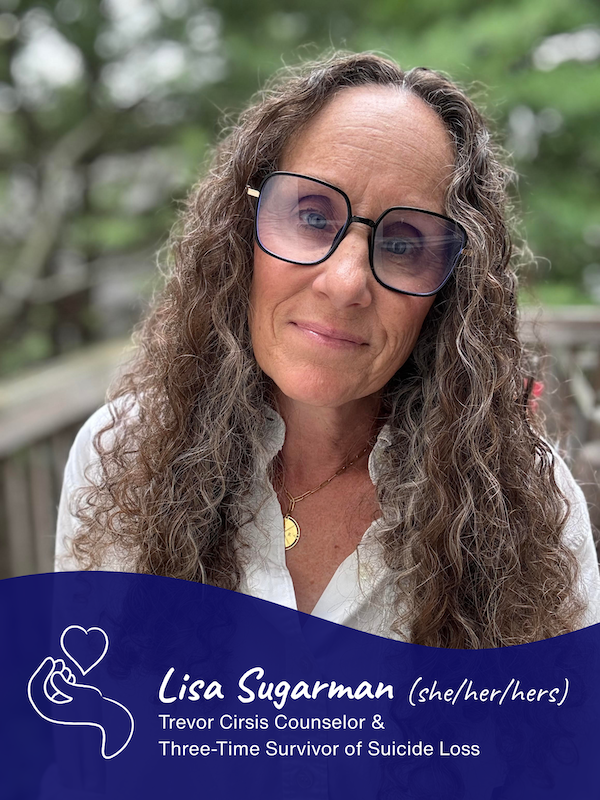
By Lisa Sugarman, 3x suicide loss survivor, Trevor Lifeline Counselor, and Founder of The HelpHUB™
When you lose someone you love to suicide, your world doesn’t just break—it shifts. Permanently. And on International Survivors of Suicide Loss Day (observed on the Saturday before Thanksgiving), and every day after, we acknowledge the millions of people around the world who are learning to live inside narratives they never asked to carry.
This day is a reminder that grief after suicide isn’t something you “get over” or “move past.” It’s something you learn to navigate, layer by layer, as you rebuild yourself in the wake of unimaginable loss.
I’ve survived suicide loss three times in my life, and each time, it carved out a different part of me. Each time, I felt a mixture of shock, confusion, guilt, anger, and love, all tangled together. And each time, I learned something new about what it means to survive the nuanced kind of loss that suicide brings.
Now, as a crisis counselor on The Trevor Project’s Lifeline, I sit on the other side of the conversation. I engage with LGBTQ+ young people in their darkest moments and remind them that their pain is real, that they deserve support, and that they matter. It’s a full-circle experience—carrying my own losses while holding space for others who are trying to survive theirs.
And what I’ve learned, both personally and professionally, is this:
Survivors of suicide loss need support that’s consistent, compassionate, and human. Not perfect. Not polished. Just human.
In recognition of International Survivors of Suicide Loss Day, here are ways we can show up for people we care about who are grieving a loss that changed them forever.
How You Can Support Survivors of Suicide Loss Today and Every Day
1. Say Their Loved One’s Name Out Loud
Saying their name—even once—can acknowledge their life and it shows you remember. And for survivors, that matters more than you know.
One of the heaviest parts of losing someone to suicide can be the silence that follows. People often avoid mentioning the person who died because they’re afraid of “making it worse.” And while that’s totally understandable, that silence is what can hurt the most.
A simple, “I was thinking about your brother today” or “I remember how much your friend loved music” tells them: Your person still exists in the world through us and we won’t forget them.
2. Listen Without Trying to Fix Anything
Listening without fixing can say: “I see you and I’m here with you and you don’t have to carry this alone.” Many survivors don’t need explanations, clichés, or someone to rush in with answers. Instead, they need someone safe enough to hold space for them and just be present.
You don’t have to have the right words, because no one does. Give yourself permission to say: “I don’t know the perfect thing to say, but I’m here in whatever ways you need me to be.”
Grief after suicide isn’t a problem to solve. It’s a story that needs a witness.
3. Understand That Grief Doesn’t Have a Timeline
Check in regularly. Not just in the immediate aftermath but in the long quiet afterward. Send a text. Suggest a walk. Meet for a cup of coffee. And ask, “how’s your heart today?” Because where healing is concerned, consistency means everything.
Support floods in right after a suicide, like with most losses. But it fades quickly, often long before the shock wears off.
For survivors, the hardest part often comes when the meals have stopped, when life around them returns to normal, and when they’re waking up months later still unsure how to make it through the day without their person.
Oftentimes, the most powerful support you can offer is your ongoing presence.
4. Validate Their Feelings and Avoid “At Least” Statements
Grief calls for empathy, not silver linings. This can be shown by staying away from phrases like:
“At least they’re not suffering.”
“At least you had time with them.”
“At least they’re in a better place.”
Even though the intention may be to offer comfort, these phrases can inadvertently minimize pain. You can instead, say things like:
“This must hurt so much.”
“I’m here with you.”
“Your feelings make sense.”
5. Encourage Connection
It can be tempting for survivors to isolate after suicide loss. Sometimes it feels easier to hide than to navigate conversations and emotional triggers.
But connection—even the simple, quiet kind—can be a lifeline. So invite survivors to do things that don’t require emotional performance:
A quiet walk
A movie
Grabbing coffee
Running errands side by side
Connection doesn’t have to be loud. It just has to be there.
6. Offer Practical, Specific Help
Grief is exhausting, especially suicide grief that’s so nuanced with things like the why, the guilt and blame, the sudden trauma, and the social stigma. It drains cognitive energy, emotional bandwidth, and physical strength.
So instead of saying: “Let me know if you need anything,” (which puts the burden back on the grieving person) try:
“I’m heading to the store—can I grab you some groceries?”
“I made dinner. I’ll leave it on your porch.”
“I can walk your dog this week if that would help.”
“I’m free Thursday if you want company at that appointment.”
Specific offers feel doable, while general offers can be overwhelming.
7. Remember the Hard Days (and the Soft Ones)
Days like anniversaries, birthdays, holidays, and especially the day they lost their loved one can remind suicide loss survivors of the life they once had. These dates can carry enormous emotional weight.
Offering a quick message of support like: “I know this week might be hard. I’m thinking of you.” often help make a survivor feel seen in a moment when invisibility feels unbearable.
Some Final Thoughts
Surviving suicide loss can bring about significant personal changes—the way you love, the way you trust, the way you move through the world. It can reshape your heart in ways you never asked for or expected.
With the right support, survivors can find connection, resilience, and even meaning alongside the pain.
If you’re a survivor reading this, please remember: There’s nothing wrong with the way you’re grieving. Grief is personal and it doesn’t have a timeline. And you deserve support that honors the depth of your unique loss.
No one should have to walk through suicide loss alone. And no one has to.
If you or someone you know is struggling, The Trevor Project is here 24/7/365 for LGBQTQ+ young people. Because every story deserves to continue, and every survivor deserves a community that shows up no matter what.
Lisa Sugarman is an author, a nationally syndicated columnist, a 3x survivor of suicide loss, a storyteller with the National Alliance on Mental Illness (NAMI), a crisis counselor with The Trevor Project, and a mental health advocate. She’s also the Founder of The HelpHUB™, the most inclusive and comprehensive free online destination for mental health resources, tools, crisis hotlines & content. Lisa is also the cohost of The Survivors Podcast and a facilitator for Safe Place, the virtual support group for survivors of suicide loss at Samaritans Southcoast in Boston and the author of Surviving: Finding Hope After Suicide Loss, How To Raise Perfectly Imperfect Kids And Be Ok With It, Untying Parent Anxiety, and LIFE: It Is What It Is. She’s also a contributor on the Mental Health Television Network (MHTN) and her work has appeared on Calmerry, Healthline Parenthood, GrownAndFlown, TODAY Parents, Thrive Global, LittleThings, The Washington Post, and Psychology Today. Lisa lives and writes just north of Boston.